Shanxian Mutton Soup
Endorsing a Bowl of Soup
Standards · Traceability · Stewardship
Ensuring that every bowl of mutton soup bearing the name "Shanxian" lives up to that name
Standards · Traceability · Stewardship
Ensuring that every bowl of mutton soup bearing the name "Shanxian" lives up to that name
The cooking technique of Shanxian Mutton Soup was inscribed on the list of Shandong provincial intangible cultural heritage (2013); Shanxian Mutton Soup is a geographical indication (GI) protected product (2015); and the Shanxian Qingshan goat used for simmering is a GI-protected agricultural product (2014). Behind a single bowl of soup lie more than two hundred years of craftsmanship and a pillar industry of the county.
Data sources: People's Daily Online Shandong Channel (March 2026) and public reports of the Shanxian Converged Media Center.
Standard setter · trademark administrator · traceability service provider · cultural narrator. It provides services in accordance with the Standardization Law, the Trademark Law and the regulations on the management of social organizations,It conducts no certification, appraisal or awards-rating activities.
In accordance with Article 18 of the Standardization Law, the association formulates the group standard for Shanxian Mutton Soup, covering selection of ingredients, cooking, bottling, sterilization and inspection. The standard is open to voluntary adoption by the public, and the standard text is open to public access.
The collective trademark "Shanxian Mutton Soup" is administered under the Trademark Law: application, review, authorization, annual self-discipline inspections and withdrawal for non-compliance; the association also assists enterprises in applying to the China National Intellectual Property Administration for the right to use the special geographical indication mark.
It has built a "from goat to bowl" traceability platform that records six stages — breeding, slaughtering, simmering, bottling, inspection and distribution — providing technical services to member enterprises.
It organizes participation in exhibitions, e-commerce livestreaming bases and cultural promotion of the production area; it assists the right holders of the geographical indication and the collective trademark in protecting their rights and safeguarding the reputation of the production area.
How far a bowl of soup can travel depends on how deep the soil beneath it is.
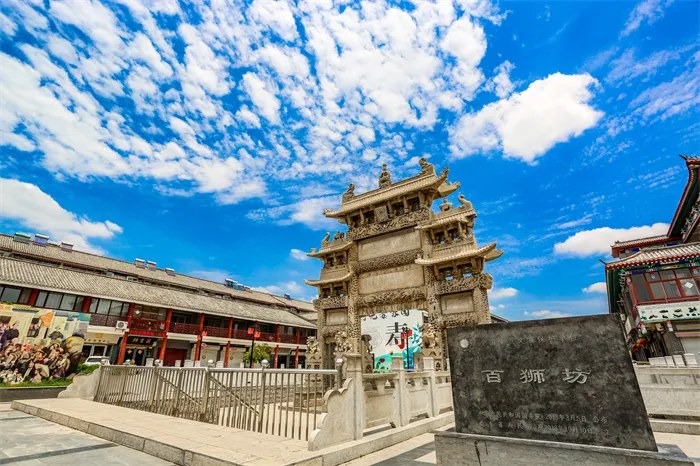
Shanfu County was established under the Qin Dynasty, giving the area a history of more than 2,200 years as a county. It was here that Mi Zijian, a disciple of Confucius, governed "to the strains of the zither" (mingqin er zhi). The two Qing-Dynasty stone archways, Baishoufang and Baishi Fang, are Major Historical and Cultural Sites Protected at the National Level. Li Bai, Du Fu, Gao Shi and Tao Mian composed poetry at the Zither Terrace, and history knows them as the "Four Gentlemen of the Zither Terrace".
Learn About Two Thousand Years of Shanfu →
From Jingui Yaolue (Synopsis of Prescriptions of the Golden Chamber) and Yinshan Zhengyao (Principles of Correct Diet) to Bencao Gangmu (Compendium of Materia Medica), written accounts of mutton as a delicacy stretch across a thousand years; also covered are the traditional pairings and eating customs of Shanxian Mutton Soup, and its sensory character of being "milky-white like milk, a seamless fusion of water and fat, fresh and free of gaminess".
Read About Food Culture →